
70th Street Trolley Station
La Mesa CA

The 70th Street Trolley station is part of San Diego’s Green Line, in La Mesa.
Completed in 2005.
Parsons Brinkerhoff, Kathryn Lim architect. KTU+A Landscape. SANDAG and Project Manager, Jim Hecht.
Sculpture, light installation, 36 light pole bases with quotes, native plant plaques in cast metal, recycled glass, benches and stonework.


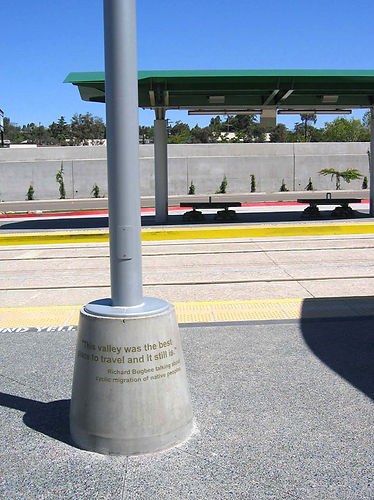
Light poles have concrete bases that have sand blasted text. See the bottom for the full text.
.
The Train-like Apparatus Sculpture
This piece is made of Found Objects, meaning that it has actual train parts and an actual metate stone. It is also kinetic, as the viewer moves the switcher arm, it runs a wheel on the metate and moves a painting on the signal disc. The painting is black and white to invoke an older time and is my rendition of what Alvarado Creek might have looked like.
The sculpture's placement is a bit different. Usually an art piece has lights, is on a central platform and directs a viewer to see it as art. I put the sculpture in a hidden place, one where someone might go for a bit of quiet while waiting for the trolley or a bus. It is the sort of thing that would catch your eye only after sitting there a while. I hope for a curiosity and then a manipulation to try and figure out what the heck it is. Could this be art if someone didn't tell me so? Either way its fun to get your hands on train equipment and make it move.
There are many plaques that speak about the native plantings. Cast in metal, they educate and endear viewers to the original landscape, well before the trolley.


In the historical map case
This is a map of the major Native American settlements of this area circa 1800. Please notice that the trails used to get from one settlement to another will ultimately become modern roads and freeways. The river and streams were very important as travel corridors as well as for food, water and navigation. The settlements and trails were convent for Spaniards to usurp as their own. Special thanks to Ricard Carrico for his research.
The other side is all about the geology of the site.
Special thanks to Dave Bloom and San Diego State University for the information.
Here is the list of all the pole base quotes.
Everyone lives downstream from someone else
Anonymous
Adopt the pace of nature, her secret is patience
Ralph Waldo Emerson
Many of the world’s people must walk 3 hours to fetch water.
Haste, haste has no blessing
Swahili proverb
The average annual rainfall in La Mesa is 13 3/4 inches. The average American uses 150 gallons of water a day.
Censorship can happen without your realizing it
N. Karavasiles
Your recycled plastic bottles make the wood-like substance of the benches.
All the stone here have been bather from the original Alvarado Creek below us.
Everything comes to him who hustles while he waits.
Thomas A Edison
Your thumb is the same length as your nose.
California is the only state in the union where you can fall asleep under a rose bush in full bloom and freeze to death.
WC Fields
The rose’s fruit, known as the hip, contains more vitamin C than oranges.
Rosa Californica
This valley was the best place to travel and it still is
Richard Bugbee talking about cyclic migration of native peoples
Everything must go somewhere
Barry Commoner
Your best teacher is your last mistake
Nathra Nader
It is better to travel well than to arrive
When the well’s dry, we know the worth of water
Benjamin Franklin
The traveler sees what he sees, the tourist sees what he has come to see
Gilbert Keith Chesterton
We are know forever by the tracks we leave
Dakota
Many a trip continues long after movement in time and space have ceased
John Steinbeck
We cannot solve the problems that we have created with the same thinking that created them
Albert Einstein
There is nothing in a caterpillar that tells you its going to be a butterfly
R. Buckminster Fuller
There are no shortcuts to any place worth going
Anonymous
We learn from history that we do not learn anything from history
Anonymous
How could solar power possible benefit us?
What could we do with recycled glass?
The average car commuter generates about 7,350 lbs of carbon dioxide per year
It takes 39,000 gallons of water to produce the average domestic auto
It is not safe to drink water directly from streams anymore.
Juncus was used as a wrapping material with deer grass for baskets
The U.S. Fish and Wildlife Service estimates that 70% of the wetland riparian habitat nationwide has been lost or altered. This project has created approximately 3 acres of habitat for every acre we impacted.
Wild strawberry, sangria Chiloenis
If you can find this before another creature, this tiny berry is sweet and delicious.
The Spaniards, when the arrived in 1769, renamed all the natives “Mission Indians”


Sometimes a good idea goes bad. The clean lines of the concrete bases which too so long to make are seen here obliterated by the vending machine. MTS apparently, sometime after the opening, decided to monetize the platform and chained the machines to the poetic art/light.
The large form of the machine makes it easy to use as a bathroom, ironically the bathroom had been removed for cost savings. I hope you don't think I did that.

The Green Line
The entire article
I’m a trained sculptor and, for the last 25 years, I’ve made my living by making art. Somewhere along the line my interest in making things – making art – grew into a love for saving things, reusing things, restoring things, reviving things. So when I won a competition and became a member of a design team that was tasked with creating a new trolley station, I was eager to apply my “green” aesthetic.
Operated by the Metropolitan Transit Development Board (MTDB), San Diego’s Metropolitan Transit System includes a light rail trolley network that traverses 48 miles of the busiest transportation corridors in San Diego County. However, as more people moved into San Diego’s east county, congestion on the freeways dramatically increased inspiring MTDB to add a trolley line extension in 2005. The Green Line, as this extension is called, includes four new stations and fills a 5.9 mile gap in the trolley network. MTDB projects that the Green Line will generate 11,000 new trolley trips a day and attract 2.5 million new trolley riders per year as a result of the increased capacity and connectivity.
When MTDB initiated the development of the Green Line, they hired four separate teams of design experts to create four unique trolley stations. For the 70th Street station in La Mesa, Parsons Brinckerhoff and KTU+A Landscape Architecture and Planning were chosen to provide architecture, engineering and landscape architecture services while I was selected to create an original public artwork that transcended the typical add-on of a statue or fountain, something that would actually become integrated into the site.
The site for the 70th Street trolley station, widely surrounded by parking lots, trailer parks, billboards, restaurants, condominiums, car dealerships, gas stations and other tell-tale evidence of suburban sprawl, began as an asphalt lot in a former river bed, bordered on one side by a water-carved cliff and the Interstate-8 on the other. Construction of the I-8 had dwarfed the site and made it into an inconspicuous haven for homeless encampments and the once glorious river had been reduced to the debris-choked Alvarado Creek.
Seeing the burden of neglect imposed on this patch of land by the development of the surrounding cityscape, I felt compelled to restore it to some of its original, natural beauty. I wanted to reclaim this land for itself as well as for the San Diego commuters who would soon be using the trolley. I also conceived the idea of providing a habitat for animals, insects and birds. Creating a natural oasis amid the crisscrossing chaos of urban life became my goal, environmental stewardship became my message, native plants became my primary medium.
To begin conceiving a “green” artwork, I assigned some parameters to my creative process. Firstly, I wanted each of my choices to be based on sound environmental practices. Secondly, I wanted the artwork elements to be beautiful as well as inspiring enough to compel future designers to follow a “green” philosophy. Thirdly, I wanted to create a self-sustaining ecosystem where all the natural elements at the station could exist and thrive harmoniously. As my brainstorming continued, new goals emerged. I thought about promoting public transportation as a choice not just a necessity and as a means for minimizing environmental impact. What could attract more riders? What would be interesting to people who wait at this same station day after day? What could they do in the 12 minutes between each trolley arrival? I thought about educating these riders, possibly 2.5 million in one year, about environmental stewardship. I asked, “What would I do if I were waiting?” I concluded that I would investigate my surroundings. These musings were the basis for the artwork elements that I finally installed at the trolley station.
The platforms of the station itself were installed in a pattern that roughly mimics the actual path of Alvarado Creek which now runs underground in this area. Along the platforms, tall lamp posts for illuminating the station at night were installed, each with a concrete base that I sandblasted with a quote. Thirty six quotes in all, some are philosophical, some are straight facts, others pose a question, but all are intended to spark conversation and introspection. Another art element that references the history of the river is a handmade historic map case which shows the locations of Native American villages along the river banks. In addition to teaching about the historic uses of the river, the presence of the map case conceptually links the old waterways with the current transportation methods and corridors. High efficiency LED lights which cast a blue hue have also been strategically placed to mark the location of the underground creek.
In my design, I specified that certain areas on the concrete surface of the station platforms should be embedded with thousands of tiny recycled glass chips, which add an attractive sparkle, demonstrate how creatively recycled materials can be used, and, hopefully, will inspire people to recycle their glass containers.
For the comfort of trolley customers, I designed benches. The base of each bench is composed of river-worn cobble stones that I rescued from the site during the early phases of site preparation and construction. The use of the cobble stones demonstrates the environmental benefits of reusing a naturally occurring material and acts as a symbolic link to the origin of the site as a river bed. The seat of each bench is made of a high quality recycled plastic “lumber”.
To reward any commuter’s investigation of the station with a discovery, I placed a sculpture titled “Train-Like Apparatus” in a largely hidden location among the foliage. The sculpture is made with parts of old train track switching equipment that, when moved, rotate a wheel upon a Native American acorn grinding stone, a metate, which was found on the project site. Painted on the switcher is an interpretive image of what Alvarado Creek looked like one hundred years ago.
Among the 40 original art elements located at the 70th Street trolley station, the highlight is the presence of native plantings and the handmade metal plaques that I made to accompany certain species. Native plants were placed at this station with the intention of educating the public about the beauty of natives and the history of their use by Native Americans and other local inhabitants. I also wanted to restore the land to its original environment, not just landscape it. I aimed to create a peaceful green oasis for both humans and animals in this harsh urban setting.
Southern California, the San Diego area in particular, is home to an amazingly diverse native flora. I selected the native species based on several criteria: local nativity, plant community, availability, and ethnobotanical uses. I specified plants that were appropriate for the trolley station customers and operators: few thorns, no branches that would grow to a height that could conceal spaces, plants that could exist at our elevation, hearty plants that could withstand abuse from the pedestrian traffic, nothing that dropped colored berries onto the hardscape. Some of the plants and trees I selected include: Deer Grass (Muhlenbergia Rigens), Elderberry (Sambucus Mexicana), Coastal Sagebrush (Artemesia Californica), White Sage (Salvia Apiana), Arroyo Willow (Salix Lasiolepis), Western Redbud (Cercis Occidentalis), Lemonade Berry (Rhus Intergrifolia), Bear Berry, Holly Leaf Cherry, Stawberry, , Blackberry .
The plants, purchased from Tree of Life Nursery in San Juan Capistrano and Las Pilitas Nursery in Escondido, were installed with local, stabilized, decomposed granite with cobble stone mulch in order to conserve water. Soil amendments were added to counter the heavy excavation done during the construction of the station. However, fertilizer wasn’t added in the interest of promoting a natural mycorrhizal soil environment.
To emphasize the educational aspect of planting natives, I created bronze, brass, and aluminum markers, or plaques, which I securely anchored into the soil next to specific plants. To take these plaques beyond their traditional shapes and roles in gardening and landscaping, I provided text about the uses for each plant in addition to the species name and I created a new, handmade style for these markers. My hope was that the handmade quality of these plaques would convey the spoken word or something passed down over time. I did not want the plaques to appear or read like something from a text book, but rather like something from a historical family story.
The native plantings have already inspired new stories. I was recently surprised and delighted during an inspection of the site when a commuter approached me excitedly with an acorn from one of the newly planted Coast Live Oaks (Quercus Agrifolia) in her hand. She told me that she had never seen a real acorn; she had only heard about them on TV in association with squirrels. She was so thrilled with her discovery that she took the acorn home to display on her coffee table.
Proper maintenance of the plants will ensure that they remain the main source of interest, education, and peaceful respite at the 70th Street trolley station. I discovered that many seasoned landscapers and landscape maintenance personnel are unfamiliar with the appropriate methods for caring for natives so I collaborated with the staff at Las Pilitas Nursery to write a native plant maintenance manual for the station operators to use as a guide. The manual emphasizes the fact that native plants, unlike ornamentals and exotics, usually do not require additional fertilizer after planting. The manual also includes tips about the proper frequency and amount of irrigation required during both the establishment and post-establishment phases.
Even with the availability of my plant maintenance manual, the frequency and scope of maintenance efforts may be limited by the same budget constraints that many government agencies are faced with today. To counter these possible shortfalls and to further community engagement with the site, I am currently working to organize local residents to participate the upkeep of the plants at the station. I have recently been in contact with a group of local Native American basket weavers to talk with them about performing some of the pruning especially of the Deer Grass (Muhlenbergia Rigens) as that is commonly used in basket weaving. Lorene Sisquoc, my primary contact, has indicated that many of her fellow weavers have had difficulty finding Deer Grass (Muhlenbergia Rigens) untreated by pesticides. My hope is that the station will become known among locals as a place to safely harvest this grass, as well as other natural goodies. In the spring, the station will yield a crop of organic Strawberries, Blackberries, will follow in the summer. Hobbyists might enjoy collecting the Elderberry to make yellow dye and even gourmets might like the Rose Hips, Lemonade Berry (Rhus Intergrifolia) and White Sage (Salvia Apiana).
My involvement with this project is going on seven years, two of which were dedicated to the construction alone. In this time, I have reflected on some of the success and failures I experienced. Should I ever be involved in a future project to design and develop another native plant habitat, I will follow these few simple guidelines:
Be clear that this is not gardening or landscaping, but rather creating an ecology. This concept should be sustained from the early design phase through the maintenance phase.
Hire a landscaping crew based on their knowledge of native plants, not on the lowest bid. Many capital projects initiated by government agencies have a requirement to award jobs to the lowest bidders. While this practice may save taxpayers some money initially, it can backfire if the contractors do not have the highest level of competency. The success of a native plant habitat depends on the knowledge the landscapers have about caring for each species.
Don’t mix the water requirements of the species during the design and planting phases of a project. Put riparian plants together with other riparian plants and the more xeric species in another area. Barriers between the two are not appropriate.
Ensure that all plant specifications are written accurately in contracts. To hold suppliers accountable, provide detailed terms, from nursery stock size and quality to post-planting upkeep, in written contracts.
Be familiar with the plant supplier. Since projects funded by government agencies are typically controlled with a series of checks and balances, inadequate documentation of expenditures can be problematic. I have learned to minimize this problem by finding plant suppliers that operate conscientiously with my same business values.
Know how the landscape will be maintained before starting. If the funding agency cannot provide frequent maintenance or high water levels, native plantings will be a good solution.
Don’t be afraid to work out of discipline. Research is fun and informative. As an artist, my training isn’t in horticulture, but I was as knowledgeable, or even more so, than some of the landscape, due to my research.
Really know the site. During the development of the trolley station project, I was aware that the site was a river bed with an existing underground creek. However, had I done some exploratory digging on the site before designing the plantings, I would have learned that standing water was present in some places. I could have designed accordingly.
Involve others. Connect with geologists, ornithologists, photographers, engineers, musicians and basket weavers. The project can be richer with input from experts in other disciplines. Plus, these people can help foster greater community support for the project
Advertise and build support. A quote from Baba Dioum that appears at the trolley station reads: “In the end we will conserve only what we love. We love only what we understand. We will understand only what we are taught.” During all phases of the project, I told people about my commitment to use native plants for this project. I discovered that this word-of-mouth sharing was very effective in generating support for this project as well as in influencing others to consider using native plants for their projects
In just a few months, the 70th Street trolley station has already been experienced by a wide variety of people who have responded to the native plantings and other art elements. Bus drivers on break eat their lunches surrounded by the Sycamores and Strawberries. High schoolers stop me to talk about how much they like the art and how much they wish all the trolley stops had public art. A politician informed me that she had taken a class on native plantings and she was delighted to see some examples at the station. A local dance troupe performed at the site. To see so many different people enjoying my work at the trolley station has been very rewarding. I see them as part of the ecology I created, partners in a harmonious relationship with native plants and public art.
Nina Karavasiles is an artist, organic gardener, and vegetarian cook. She lives off the grid in Warner Springs, CA. www.ninak.info